


The global shift toward remote work culture, accelerated by the COVID-19 pandemic, has fundamentally transformed not only how we work but also how we relate to and care for our companion animals. This transformation has created a cascade of changes in pet ownership patterns, consumer spending behaviors, and the intimate dynamics between humans and their pets. The convergence of increased time at home, heightened emotional bonds with pets, and evolving lifestyle preferences has driven unprecedented growth in premium pet care product consumption while simultaneously reshaping the psychological and economic foundations of pet ownership.
The Remote Work Revolution and Its Timeline
The transition to remote work represents one of the most significant workplace transformations in modern history. Prior to 2020, remote work remained a niche arrangement, with only approximately 7% of the workforce engaged in full-time remote work arrangements. The pandemic catalyzed an immediate and dramatic shift, with remote work adoption surging to 42% by mid-2020, fundamentally altering the employment landscape across industries and demographics.
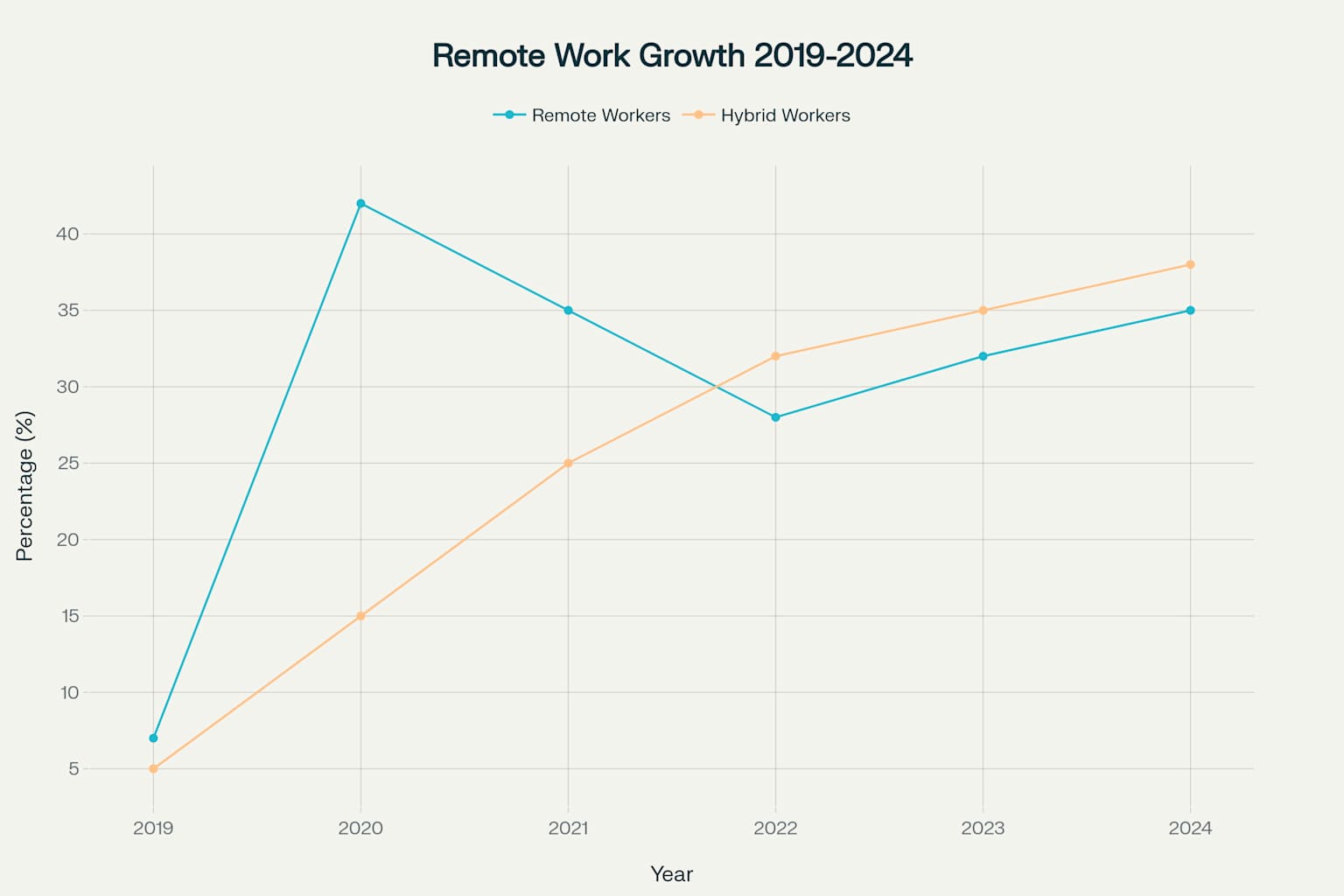
Remote and Hybrid Work Adoption Trends (2019-2024)
This dramatic workplace transformation created an unprecedented scenario where millions of workers found themselves spending substantially more time in their homes, often in the company of their pets. The subsequent years have witnessed a stabilization of remote work arrangements, with hybrid models gaining particular prominence, reaching 38% adoption by 2024. This sustained presence of workers in home environments has created new opportunities for human-pet interaction and has fundamentally altered the dynamics of pet care and ownership.
Surge in Pet Adoption During the Remote Work Era
The early months of the pandemic witnessed an extraordinary increase in pet adoption interest, with search volumes for both dog and cat adoption increasing by up to 250% compared to 2019 baseline levels12. This phenomenon, often referred to as the “pandemic pet boom,” was driven by multiple converging factors including increased time availability, desire for companionship during isolation, and the practical feasibility of pet training and integration when working from home.
Research conducted through Google Trends analysis revealed that while dog adoption interest eventually returned to more normal levels by late 2020, cat adoption interest remained sustainably elevated throughout the observation period12. This differential pattern likely reflects cats’ better adaptation to indoor living arrangements, making them particularly suitable companions for remote workers who spend extended periods at home.
The demographics of new pet adopters during this period skewed toward younger, educated, and higher-income individuals who were more likely to have jobs amenable to remote work arrangements34. Approximately 70% of remote employees adopted a pet during the pandemic, with 42% choosing dogs and 28% choosing cats3. This massive influx of new pet owners, many of whom were first-time pet parents, created a substantial new market for pet care products and services.
Transformative Changes in Pet Spending Patterns
The shift to remote work has created measurable differences in pet spending behaviors across different work arrangements. Remote workers demonstrate significantly higher annual pet expenditure patterns compared to their hybrid and in-office counterparts, with implications extending far beyond basic necessities to premium product categories.
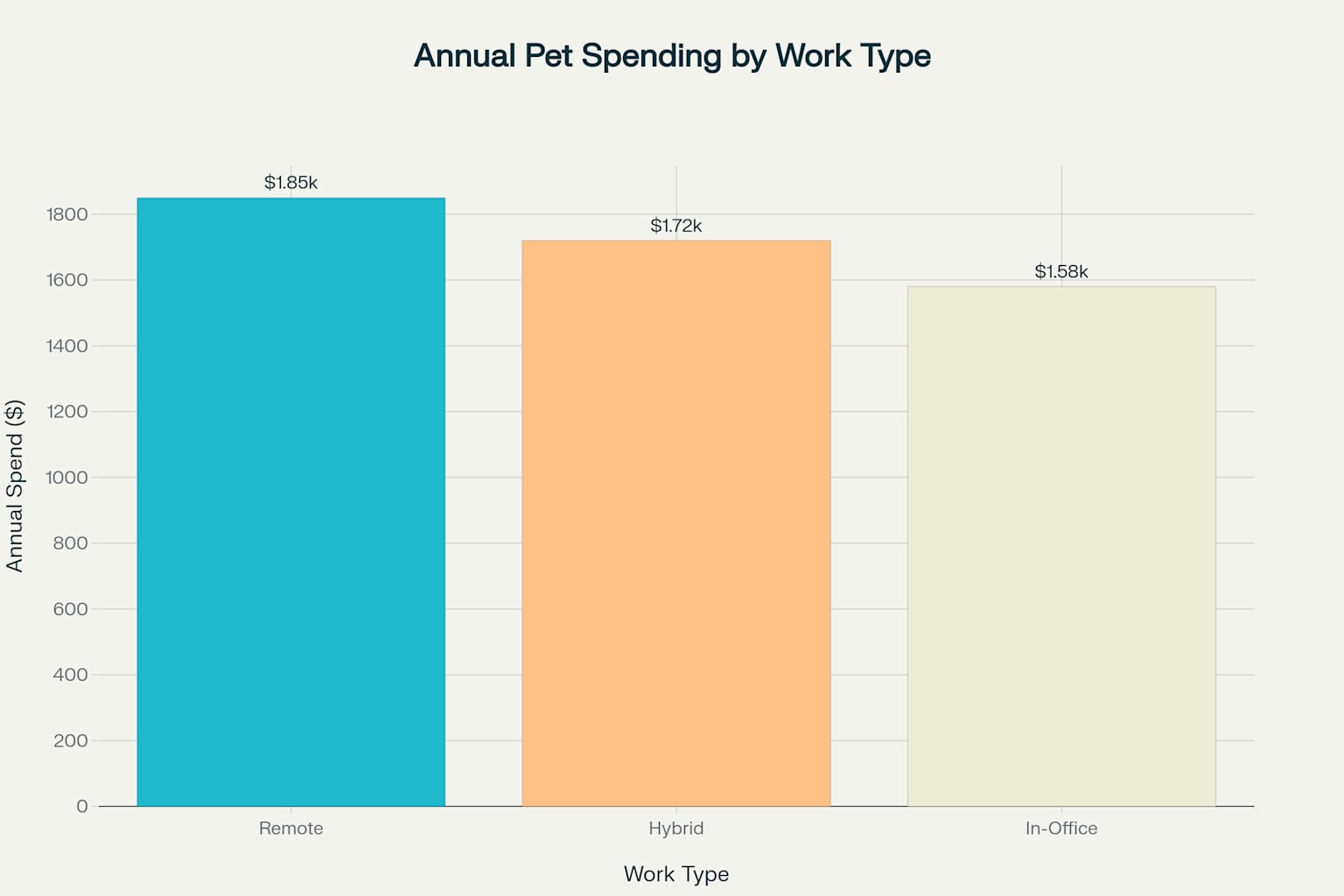
Annual Pet Spending by Work Arrangement
The enhanced spending patterns among remote workers reflect several interconnected factors. The financial savings from reduced commuting costs, estimated at approximately £8,742 annually for dog owners in the UK5, provides additional disposable income that is frequently redirected toward pet care expenses. More fundamentally, the increased daily interaction time between remote workers and their pets has intensified emotional bonds, leading to what researchers term “pet humanization” – the tendency to treat pets as family members deserving of premium care and products.
Premium pet product adoption rates demonstrate even more pronounced differences across work arrangements. Remote workers show 68% adoption of premium pet products compared to 62% among hybrid workers and 55% among traditional office workers. This pattern reflects not only increased financial capacity but also heightened awareness of pet health and wellness needs that comes from continuous observation and interaction.
The spending increases encompass multiple product categories, with particular growth in areas such as premium nutrition, health supplements, smart technology devices, and comfort-enhancing products. Pet food spending alone increased dramatically from a weekly average of $27.89 in 2019 to $39.29 in 2020, driven by both increased pet ownership and trading up to higher-quality food options6.
Evolution of Human-Pet Relationship Dynamics
The psychological dimensions of human-pet relationships have undergone profound changes in the remote work era. Extended daily proximity has intensified emotional bonds between pets and their owners, with 91% of remote workers reporting that caring for pets has improved their remote working experience78. This enhanced companionship has created measurably positive impacts on mental health, stress reduction, and overall well-being.
Research indicates that pets provide remote workers with crucial psychological benefits including reduced feelings of work-related stress (91% of respondents), decreased loneliness (50% of respondents), and improved work-life balance through mandatory breaks and outdoor activities78. The constant presence of pets during work hours has created a unique form of emotional support that differs qualitatively from traditional pet ownership patterns where pets were primarily companions during non-work hours.
The intensification of human-pet bonds has manifested in several observable behaviors. Pet owners now think about their pets approximately seven times during a typical workday and worry about them five times daily when separated9. This heightened emotional investment has translated directly into increased willingness to invest in premium care products and services that enhance pet health, comfort, and well-being.
The phenomenon of “pet humanization” has accelerated during the remote work era, with pets increasingly viewed as family members rather than animals1011. This conceptual shift has profound implications for consumption patterns, as pet owners apply similar quality and care standards to pet products as they would for human family members. The result is increased demand for organic foods, specialized healthcare products, customized nutrition plans, and premium comfort items.
Premium Pet Care Product Market Transformation
The convergence of remote work culture and evolving pet relationships has catalyzed unprecedented growth in the premium pet care market. Global pet care market expansion reflects this transformation, growing by 5.9% in 2023 to reach $197.6 billion, with the U.S. pet food industry alone projected to grow from $43.9 billion in 2023 to $59.9 billion by 203212.
The premiumization trend encompasses multiple product categories, driven by remote workers’ increased observation of their pets’ daily behaviors and needs. Premium nutrition products, including organic ingredients, raw diets, and specialized supplements, have seen particularly strong adoption rates. This growth reflects both increased disposable income among remote workers and heightened awareness of the connection between nutrition and long-term pet health.
Technology-enabled premium products represent another significant growth area, with the global pet tech market projected to expand from $7.6 billion in 2024 to $16.2 billion by 2028, representing a compound annual growth rate of 14.2%1314. These products, including smart feeders, health monitoring devices, GPS trackers, and interactive toys, appeal particularly to remote workers who value data-driven insights into their pets’ well-being and behavior patterns.
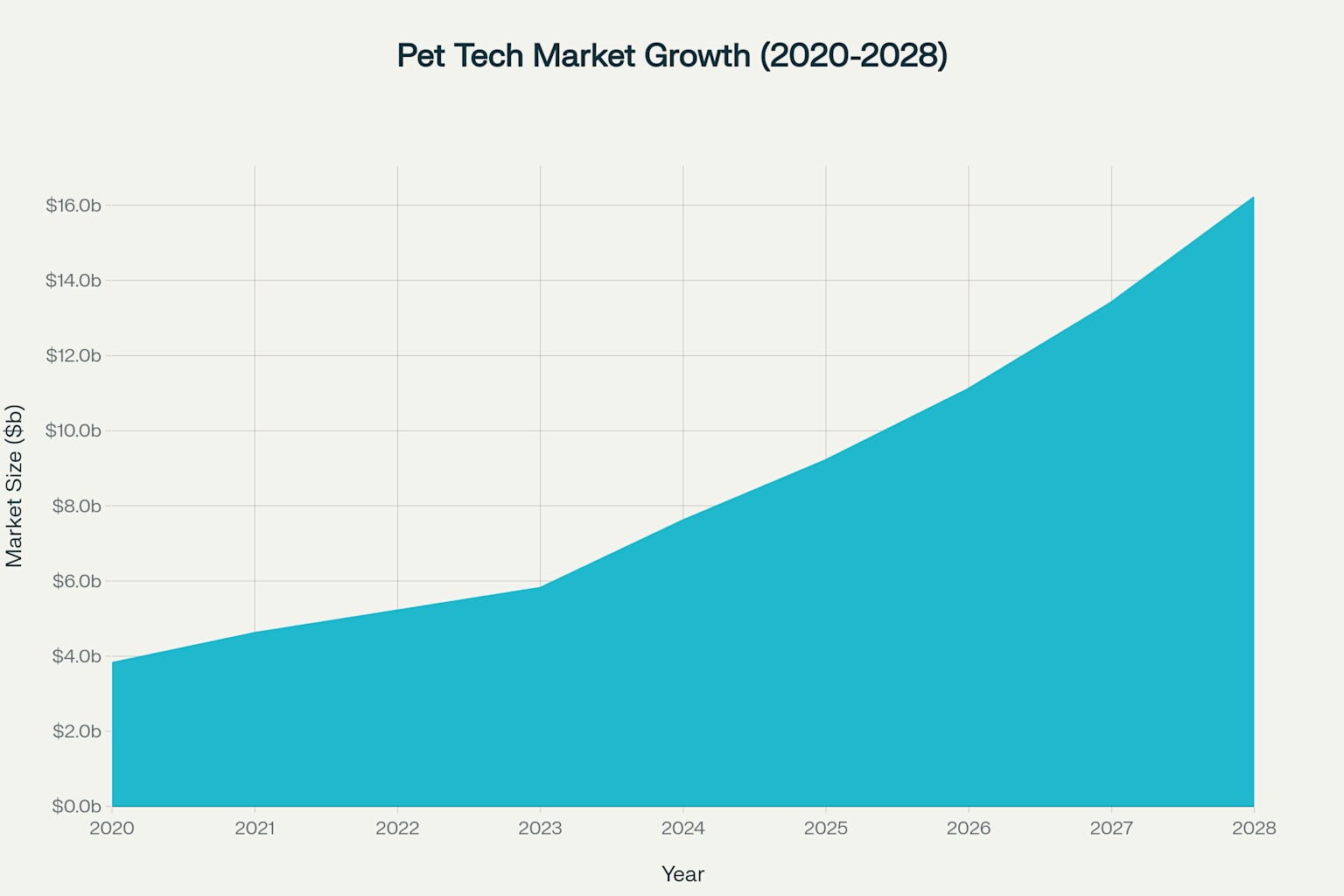
Global Pet Technology Market Growth Projection (2020-2028)
The rise of subscription-based premium services has also accelerated, with remote workers showing particular affinity for convenient, high-quality solutions delivered directly to their homes. These services range from fresh meal delivery programs to telemedicine consultations, reflecting the intersection of convenience needs and premium quality expectations that characterize remote work lifestyles.
Technology Integration in Pet Care
The remote work era has coincided with rapid advancement in pet care technology, creating synergies that have accelerated adoption of smart pet products and services. IoT-enabled devices, artificial intelligence applications, and mobile connectivity solutions have transformed pet care from a primarily analog experience to an increasingly data-driven and technology-mediated relationship.
Smart collar technology exemplifies this transformation, with devices now capable of monitoring vital signs, activity levels, sleep patterns, and behavioral indicators1516. These technologies provide remote workers with unprecedented insights into their pets’ health and well-being, enabling proactive care approaches that were previously impossible without constant veterinary supervision.
Automated feeding and care systems have gained particular traction among remote workers who appreciate the precision and reliability these systems provide1516. Smart feeders can deliver precisely measured portions on customized schedules, while automated waste management systems reduce the manual labor associated with pet care. These technologies allow remote workers to maintain optimal pet care standards even during intensive work periods.
The integration of telemedicine and virtual veterinary consultations has expanded dramatically during the remote work era, with 85.7% of pet owners and 67.4% of veterinary professionals supporting continued offering of telemedicine services17. This technological integration provides remote workers with convenient access to professional veterinary expertise while maintaining the flexibility that defines remote work arrangements.
Psychological and Emotional Dimensions
The psychological impact of enhanced human-pet relationships in the remote work context extends beyond simple companionship to encompass complex emotional and therapeutic benefits. Research demonstrates that pet presence during remote work provides measurable stress reduction, with 88% of remote workers reporting that their pets help them be more productive and 87% indicating that pet proximity helps them better cope with work-related stress18.
The phenomenon of “emotional substitution” has become particularly relevant among remote workers with limited social support networks. Studies indicate that dogs may serve as emotional substitutes for human companionship in socially vulnerable individuals, particularly among those with lower perceived social support19. This dynamic has intensified during the remote work era as traditional workplace social interactions have diminished.
The concept of “skin hunger” – the psychological need for physical touch and comfort – has gained prominence during the remote work era, with pets providing crucial tactile comfort that might otherwise be absent from home-based work environments20. The desire for touching both human bodies and pet animals increased significantly after the COVID-19 outbreak and has remained elevated, highlighting the fundamental role pets play in meeting basic human psychological needs.
Pet attachment patterns have also evolved, with stronger emotional bonds correlating with higher investment in premium care products2122. This relationship creates a positive feedback loop where increased emotional investment leads to higher spending on pet care, which in turn reinforces the sense of pets as valued family members deserving of premium treatment.
Economic Implications and Market Dynamics
The economic implications of remote work culture’s impact on pet care consumption extend across multiple industry sectors and represent a fundamental shift in consumer spending priorities. The total economic impact encompasses not only direct pet product purchases but also ancillary services, technology investments, and lifestyle adaptations that support enhanced pet care.
Remote workers’ financial advantages, including reduced commuting costs, dining expenses, and professional wardrobe requirements, have created additional disposable income that is frequently redirected toward pet care investments. This reallocation of household budgets represents a structural shift in consumer spending patterns that extends beyond temporary pandemic-related changes.
The premium pet care market has demonstrated remarkable resilience to economic pressures, with pet owners continuing to maintain or increase spending on pet care even during periods of financial uncertainty623. This pattern reflects the deep emotional bonds that characterize modern pet ownership and suggests that premium pet care has achieved “necessity” status for many households rather than remaining a discretionary expense category.
Industry consolidation and innovation have accelerated in response to changing consumer demands, with companies developing increasingly sophisticated products and services targeted at affluent, tech-savvy remote workers1024. This market evolution has created new competitive dynamics and has attracted significant venture capital investment in pet care technology and premium product development.
Future Outlook and Implications
The intersection of remote work culture and pet care consumption appears to represent a permanent shift rather than a temporary pandemic-related phenomenon. As remote and hybrid work arrangements stabilize as long-term employment models, the enhanced human-pet relationships and associated consumption patterns are likely to persist and potentially intensify.
Technological advancement will continue to drive innovation in pet care products and services, with artificial intelligence, IoT connectivity, and data analytics creating increasingly sophisticated solutions for remote workers seeking optimal pet care2526. The integration of these technologies into comprehensive pet care ecosystems will likely accelerate, creating seamless experiences that align with remote workers’ preferences for efficiency and data-driven decision making.
The generational component of this transformation suggests sustained long-term growth, as millennials and Generation Z workers, who demonstrate the highest affinity for both remote work and premium pet care, continue to advance in their careers and accumulate greater disposable income. These demographics show particular willingness to invest in pet health, technology, and premium products, indicating continued market expansion potential.
Environmental and sustainability considerations are likely to become increasingly important factors in premium pet care product development, reflecting remote workers’ heightened environmental consciousness and their preference for products that align with their values27. This trend will likely drive innovation in sustainable packaging, ethical sourcing, and environmentally responsible manufacturing processes.
Conclusion
The impact of remote work culture on premium pet care product consumption and human-pet relationship dynamics represents a fundamental transformation that extends far beyond simple changes in purchasing behavior. This phenomenon encompasses psychological, economic, technological, and social dimensions that have created new paradigms for understanding both work-life integration and the role of companion animals in human well-being.
The data clearly demonstrates that remote workers have developed distinctly different relationships with their pets compared to traditional office workers, characterized by deeper emotional bonds, higher spending on premium products, and greater integration of technology-enabled care solutions. These changes appear to be structural rather than temporary, suggesting that the premium pet care market will continue to experience sustained growth driven by the evolving needs and preferences of remote workers.
The implications extend beyond individual consumer choices to encompass broader societal changes in how we conceptualize work, family, and the role of animals in human life. As remote work culture continues to evolve and mature, the pet care industry will likely continue adapting to serve an increasingly sophisticated, emotionally invested, and technologically enabled customer base that views premium pet care not as luxury consumption but as essential family care.
This transformation ultimately reflects the profound human need for companionship, emotional support, and meaningful relationships – needs that pets fulfill with particular effectiveness in the context of home-based work environments. The resulting economic and social changes represent one of the most significant shifts in consumer behavior and lifestyle patterns to emerge from the remote work revolution, with implications that will continue to unfold across multiple industries and social contexts in the years ahead.
- https://duieih.kiev.ua/
- https://pubs.asha.org/doi/10.1044/2024_LSHSS-24-00033
- https://www.mdpi.com/2409-515X/10/2/38
- http://www.rjeec.ro/Read/247?id=Ecological%20imbalance%20on%20the%20area%20of%20Shapahar%20Upazila,%20Naogaon%20district%20over%20three%20decades%20(1993%C3%B72023)%20and%20prediction%20trend%20next%20ten%20years%3A%20a%20GIS%20approach
- https://armgpublishing.com/journals/sec/volume-8-issue-2/article-2/
- https://articlegateway.com/index.php/AJM/article/view/7271
- https://doi.apa.org/doi/10.1037/fsh0000934
- https://www.recentadvancesin.com/wp-content/uploads/2024/05/rars240002.pdf
- https://ascopubs.org/doi/10.1200/JCO.2024.42.16_suppl.e23193
- https://ieeexplore.ieee.org/document/10735888/
- https://pmc.ncbi.nlm.nih.gov/articles/PMC11208135/
- http://arxiv.org/pdf/2402.18459v1.pdf
- https://us.neat.no/resources/top-remote-work-statistics/
- https://www.venn.com/blog/exploring-remote-work-trends-millennials-gen-z-lead-the-way/
- https://extension.usu.edu/remoteworkcertificate/files/infographic-rw-adoption-2023.pdf
- https://ceoworld.biz/2023/05/08/remote-work-and-its-effects-on-work-life-balance/
- https://techjury.net/blog/hybrid-work-statistics/
- https://www.roberthalf.com/us/en/insights/research/remote-work-statistics-and-trends
- https://nordlayer.com/blog/home-is-the-new-office-remote-work-trends/
- https://www.matsh.co/en/statistics-on-remote-work-preferences/
- https://www.reddit.com/r/remotework/comments/1gjfyhw/why_remote_work_is_healthy_read_this/
- https://archieapp.co/blog/hybrid-workplace-stats/
- https://www.bls.gov/productivity/notices/2024/productivity-and-remote-work.htm
- https://vocal.media/journal/the-future-of-remote-work-trends-shaping-the-new-normal
- https://www.weforum.org/stories/2021/04/working-from-home-what-we-learned/
- https://explodingtopics.com/blog/remote-work-statistics
- https://www.zippia.com/advice/hybrid-work-statistics/
- https://www.uscareerinstitute.edu/blog/50-eye-opening-remote-work-statistics-for-2024
- https://explodingtopics.com/blog/remote-work-trends
- https://www.ifo.de/DocDL/EconPol-PolicyBrief_53_Working_from_Home.pdf
- https://www.diagnosticeyecenter.com/2024/04/11/maintaining-health-remote-work/
- https://techreport.com/statistics/business-workplace/hybrid-work-statistics/
- https://www.spiedigitallibrary.org/conference-proceedings-of-spie/12574/2665499/Development-of-holographic-optical-elements-for-use-in-wound-monitoring/10.1117/12.2665499.full
- https://www.ijcmph.com/index.php/ijcmph/article/view/13033
- https://www.vestnik-atu.kz/jour/article/view/2398
- https://proceedings.unisba.ac.id/index.php/BCSSEL/article/view/14045
- https://www.ahajournals.org/doi/10.1161/CIR.0000000000001209
- https://dx.plos.org/10.1371/journal.pgph.0003269
- https://avmajournals.avma.org/view/journals/ajvr/86/2/ajvr.24.09.0265.xml
- https://scholarhub.ui.ac.id/oemji/vol2/iss2/24/
- https://ashpublications.org/blood/article/144/Supplement%201/7775/528087/Real-World-Interim-PET-CT-Scan-Use-during
- https://bmcnurs.biomedcentral.com/articles/10.1186/s12912-024-02097-3
- https://pmc.ncbi.nlm.nih.gov/articles/PMC11017927/
- https://pmc.ncbi.nlm.nih.gov/articles/PMC11195508/
- https://www.fortunebusinessinsights.com/pet-care-market-104749
- https://angle.ankura.com/post/102j84u/premium-pet-food-industry-snapshot
- https://markets.businessinsider.com/news/stocks/the-pet-economy-boom-americans-are-spending-big-and-going-all-in-for-their-pets-1033992076
- https://www.petfoodindustry.com/pet-food-market/blog/15468622/pet-food-purchasing-habits-and-trends-of-us-pet-owners
- https://www.einnews.com/pr_news/781983434/luxury-pet-accessories-market-to-expand-at-a-cagr-of-5-3-reaching-usd-6-7-billion-by-2033-from-usd-4-0-billion
- https://www.statista.com/statistics/253976/pet-food-industry-expenditure-in-the-us/
- https://www.petfoodprocessing.net/articles/18656-report-super-premium-to-propel-us-pet-food
- https://www.valuepenguin.com/pet-spending-study
- https://www.meatpoultry.com/articles/28319-survey-pet-owners-will-pay-a-premium-for-certain-pet-food-attributes
- https://www.einpresswire.com/article/781983434/luxury-pet-accessories-market-to-expand-at-a-cagr-of-5-3-reaching-usd-6-7-billion-by-2033-from-usd-4-0-billion
- https://americanpetproducts.org/industry-trends-and-stats
- https://explodingtopics.com/blog/pet-industry-trends
- https://www.petfoodindustry.com/blogs-columns/adventures-in-pet-food/blog/15704976/us-pet-owners-spent-176-more-on-pet-food-in-2023
- https://www.petexec.net/resources/marketing/pet-spending-statistics
- https://www.gray.com/insights/what-drives-pet-food-purchases-for-todays-animal-owners/
- https://market.us/report/luxury-pet-accessories-market/
- https://americanpetproducts.org/news/the-american-pet-products-association-appa-releases-2025-state-of-the-industry-report
- https://www.ibisworld.com/united-states/industry/premium-pet-food-production/6157/
- https://www.mastercard.com/us/en/news-and-trends/stories/2025/national-pet-day-pet-spending.html
- https://www.news.market.us/luxury-pet-accessories-market-news/
- https://www.frontiersin.org/articles/10.3389/fpsyg.2022.920559/full
- https://www.sciendo.com/article/10.2478/ers-2021-0029
- https://ieeexplore.ieee.org/document/10579923/
- https://academic.oup.com/innovateage/article/7/Supplement_1/636/7488854
- https://www.semanticscholar.org/paper/03dc39aadedcefbbe8dad98bdb519291e16a5e76
- https://ieeexplore.ieee.org/document/10677676/
- https://www.tandfonline.com/doi/full/10.1080/08927936.2019.1621541
- https://www.mdpi.com/2071-1050/12/21/8829
- http://aquila.usm.edu/ojhe/vol12/iss2/4/
- https://bvajournals.onlinelibrary.wiley.com/doi/10.1002/vetr.1738
- https://www.mdpi.com/2076-2615/11/2/268/pdf
- https://pmc.ncbi.nlm.nih.gov/articles/PMC6513973/
- https://www.payentry.com/pets-and-remote-work-how-our-furry-friends-boost-productivity-and-well-being/
- https://www.petfinder.com/adopt-or-get-involved/adopting-pets/how-to/adopt-a-pet-during-covid-19/
- https://www.yourpetsdaily.co.uk/article/2024/05/15/dog-owners-could-save-%C2%A38742-year-working-remotely
- https://hrdailyadvisor.blr.com/2023/11/29/the-purr-fect-solution-how-pets-elevate-the-remote-work-experience/
- https://www.trustedhousesitters.com/blog/news/how-pet-sitting-benefits-remote-working-experience/
- https://pmc.ncbi.nlm.nih.gov/articles/PMC9264855/
- https://pmc.ncbi.nlm.nih.gov/articles/PMC9563850/
- https://remote.co/benefits-of-working-remotely-pet-owner
- https://weworkremotely.com/the-role-of-pets-in-remote-work-are-they-the-best-coworkers
- https://hrdailyadvisor.com/2023/11/29/the-purr-fect-solution-how-pets-elevate-the-remote-work-experience/
- https://total.vet/work-from-home/
- https://pubmed.ncbi.nlm.nih.gov/34046443/
- https://www.rover.com/uk/blog/working-from-home-with-pets/
- https://hrnews.co.uk/the-power-of-pets-9-in-10-remote-workers-say-pets-improve-their-mental-health/
- https://www.cherryassistant.com/blog/virtual-assistants-remote-pets-national-pets-month-spotlight
- https://vetster.com/en/lifestyle/new-data-on-pets-in-the-workplace
- https://pmc.ncbi.nlm.nih.gov/articles/PMC8145284/
- https://money.asda.com/help-and-support/money-blog/pet/can-pets-help-when-working-from-home/
- https://www.expresspros.com/BrookfieldIL/Articles/2022-08-How-to-Manage-Being-a-Remote-Worker-and-a-Pet-Owner.aspx
- https://employernews.co.uk/news/the-power-of-pets-9-in-10-remote-workers-say-pets-improve-their-mental-health-and-reduce-work-related-stress/
- https://www.frontiersin.org/articles/10.3389/fpsyg.2024.1391606/full
- https://www.frontiersin.org/articles/10.3389/fpsyg.2022.1016909/full
- https://link.springer.com/10.1007/s12144-022-03792-7
- http://www.magonlinelibrary.com/doi/10.12968/vetn.2023.14.1.50
- https://www.taylorfrancis.com/books/9780429576935/chapters/10.4324/9780429201301-10
- https://www.mdpi.com/2076-2615/15/13/1895
- https://www.tandfonline.com/doi/full/10.1080/10538712.2022.2112350
- http://www.magonlinelibrary.com/doi/10.12968/coan.2022.0021
- https://www.semanticscholar.org/paper/720682724639fc368535a5526557140afccabf6f
- https://www.ingentaconnect.com/content/10.70256/435606jqlwll
- https://pmc.ncbi.nlm.nih.gov/articles/PMC9441033/
- https://www.frontiersin.org/journals/psychology/articles/10.3389/fpsyg.2024.1391606/pdf
- https://pmc.ncbi.nlm.nih.gov/articles/PMC11171028/
- https://vetexplainspets.com/humanization-of-pets/
- https://www.starleaf.com/blog/how-emotional-support-animals-enhance-remote-work-environments/
- https://www.cabidigitallibrary.org/doi/full/10.1079/hai.2018.0006
- https://addictionstraininginstitute.com/the-healing-power-of-pets-how-animals-support-our-mental-well-being/
- https://remedypsychiatry.com/the-psychology-of-the-human-animal-bond/
- https://news.bryant.edu/future-paw-tential-businesses-creatively-tap-pet-human-bond
- https://www.calm.com/blog/pets-and-mental-health
- https://www.onehealth.org/blog/the-power-of-the-human-animal-bond
- https://royalexaminer.com/pet-humanization-trend-sparks-new-products/
- https://pmc.ncbi.nlm.nih.gov/articles/PMC11082317/
- https://countrysidekinsmanvet.com/news/mental-health-benefits-of-owning-pets
- https://gamesforchange.org/studentchallenge/atlanta/the-human-animal-bond/
- https://clearlylovedpets.com/blogs/clearly-loved-pets-blog/the-humanization-of-pets
- https://katzenworld.co.uk/2023/11/19/the-power-of-pets-9-in-10-remote-workers-say-pets-improve-their-mental-health-and-reduce-work-related-stress/
- https://jeps.efpsa.org/articles/10.5334/jeps.ao
- https://www.wellandgood.com/health/mental-health-benefits-of-having-pets
- https://kiss.kstudy.com/Detail/Ar?key=3649803
- https://www.semanticscholar.org/paper/768d31ba255c042c11135bcab1d21d062f7c1ddb
- https://journals.sagepub.com/doi/10.1177/00222429221078036
- https://www.tandfonline.com/doi/full/10.1080/10971475.2021.1890360
- https://www.emerald.com/insight/content/doi/10.1108/BFJ-10-2023-0910/full/html
- https://conbio.onlinelibrary.wiley.com/doi/10.1111/cobi.12998
- https://index.ieomsociety.org/index.cfm/article/view/ID/738
- https://al-kindipublisher.com/index.php/jbms/article/view/9368
- https://www.taylorfrancis.com/books/9781317850762
- https://onlinelibrary.wiley.com/doi/10.1155/hbe2/7290117
- http://journal.ui.ac.id/index.php/amj/article/view/12900
- https://www.mdpi.com/2072-6643/14/21/4571/pdf?version=1667198375
- https://www.petfoodprocessing.net/articles/18290-evolving-pet-ownership-leads-to-shift-in-consumer-purchasing-behaviors
- https://pmc.ncbi.nlm.nih.gov/articles/PMC8614253/
- https://clarifycapital.com/hidden-costs-of-remote-work
- https://ebusiness.avma.org/files/ProductDownloads/eco-pet-demographic-report-22-low-res.pdf
- https://www.promodo.com/blog/generational-shifts-and-behavioral-patterns-in-the-us-pet-ownership
- https://kadence.com/en-us/pet-parenting-goes-premium-as-owners-prioritize-wellness-over-cost/
- https://www.petfoodindustry.com/pet-food-market/blog/15466805/covid-19-influence-on-pet-food-consumer-trends-behaviors
- https://news.outsourceaccelerator.com/remote-work-affects-workers-spending-habits-deloitte/
- https://www.petfoodindustry.com/pet-food-market/article/15468846/dog-ownership-family-composition-and-household-finances
- https://www.petfoodprocessing.net/articles/17700-appa-dives-deep-into-pet-industry-trends-consumer-behaviors-in-new-report
- https://www.marcus.com/us/en/resources/heard-at-gs/spending-for-the-love-of-pets?msockid=1f2bb26c2fa96d801481a4662ed06cfd
- https://www.petfoodindustry.com/brand-insights/mondi-north-america/2021-updated-research-the-increase-in-pet-ownership-during-the-pandemic-resulted-in-consumer-behavior-changes-toward-purchasing-pet-food/647395870ec6330001021473
- https://www.americanpetproducts.org/news/press-release/american-pet-products-association-releases-findings-from-the-fourth-volume-of-the-covid-19-pulse-study-of-pet-ownership-during-the-pandemic
- https://www.linkedin.com/pulse/remote-work-finances-how-budget-hybrid-lifestyle-invest-n-rich-llp-0fbtf
- https://www.avma.org/sites/default/files/resources/AVMA-Pet-Demographics-Executive-Summary.pdf
- https://nielseniq.com/global/en/insights/analysis/2024/the-full-view-of-the-pet-industry-a-comprehensive-analysis-of-consumer-and-product-trends/
- https://worldanimalfoundation.org/advocate/pet-spending-statistics/
- https://americanpetproducts.org/blog/pet-owners-report-spending-more-on-their-pets-post-covid?hsLang=en
- https://www.greenprophet.com/2024/11/budgeting-for-a-life-of-remote-work-and-travel-balancing-savings-and-splurges/
- https://www.avma.org/javma-news/2020-02-01/dog-ownership-and-veterinary-visits-income-bracket
- https://jmte.eu/wp-content/uploads/2024/03/03-DUMITRESCU_JMTE_vol-1_2024.pdf
- https://link.springer.com/10.1007/s10798-022-09803-9
- https://hsetdata.com/index.php/ojs/article/view/557
- https://www.semanticscholar.org/paper/c8695c6e922b2a2a48fbc52bd3cc008b88caf885
- https://www.emerald.com/insight/content/doi/10.1108/JMTM-02-2022-0092/full/html
- https://scholar.kyobobook.co.kr/article/detail/4010068266643
- https://ieeexplore.ieee.org/document/9144910/
- http://link.springer.com/10.1007/978-3-319-30127-3_57
- http://ieeexplore.ieee.org/document/7028856/
- https://ieeexplore.ieee.org/document/10617092/
- https://www.mdpi.com/2673-4591/82/1/63
- https://www.mdpi.com/2076-2615/13/4/699
- https://www.gingrapp.com/blog/the-latest-in-pet-care-technology-trends
- https://www.researchandmarkets.com/reports/5998254/pet-tech-market-size-market-share-application
- https://promwad.com/news/embedded-systems-smart-pet-devices-iot-for-ai-tracking
- https://www.businesswire.com/news/home/20220517005049/en/Unveiling-Next-Generation-of-Pet-Care-Technology-with-Whistle-Health
- https://a-z-animals.com/articles/7-best-pet-trackers-for-2025-to-keep-your-dog-or-cat-safe/
- https://www.cincinnatifamilyvet.com/services/blog/smart-pet-technology-guide-modern-pet-care
- https://www.thebusinessresearchcompany.com/market-insights/global-pet-tech-market-2024
- https://www.intuz.com/blog/iot-enabled-smart-dog-collar
- https://www.vml.com/insight/ces-2024-elevated-pet-wellness
- https://play.google.com/store/apps/details?id=com.docupet.homesafe
- https://design1st.com/pet-tech-products/
- https://www.researchandmarkets.com/reports/6098829/pet-tech-global-strategic-business-report
- https://animalwellnessmagazine.com/how-technology-is-revolutionizing-dog-and-cat-care/
- https://velocityiot.io/revolutionizing-pet-care-the-future-of-cellular-connected-smart-collars-with-velocity-iot/
- https://www.embracepetinsurance.com/waterbowl/article/electronic-pet-trackers-and-activity-monitors
- https://news.yahoo.com/rise-smart-pet-tech-technology-162404252.html
- https://www.openpr.com/news/3963989/pet-tech-industry-report-2024-2030-global-market-projected
- https://www.themobileindian.com/top-5/top-5-internet-of-thing-devices-to-manage-pets-18072
- https://www.plugandplaytechcenter.com/resources/7-smart-pet-technologies-advancing-health-monitoring-for-pets/
- https://mobiusa.com/products/mobicam-hdx-pet-camera
- https://dx.plos.org/10.1371/journal.pone.0274630
- https://dx.plos.org/10.1371/journal.pone.0299051
- https://pmc.ncbi.nlm.nih.gov/articles/PMC9052738/
- https://pmc.ncbi.nlm.nih.gov/articles/PMC11886879/
- https://academic.oup.com/iwc/advance-article-pdf/doi/10.1093/iwc/iwad014/49356721/iwad014.pdf
- https://journals.sagepub.com/doi/pdf/10.1177/23970022221106973
- https://pmc.ncbi.nlm.nih.gov/articles/PMC9988592/
- https://www.frontiersin.org/articles/10.3389/fpsyg.2023.1258750/pdf?isPublishedV2=False
- https://www.emerald.com/insight/content/doi/10.1108/ijpsm-06-2020-0150/full/html?skipTracking=true
- https://www.mdpi.com/2813-9372/2/1/15
- https://pmc.ncbi.nlm.nih.gov/articles/PMC9558595/
- https://brill.com/view/journals/ifam/27/5/article-p903_5.xml
- https://pmc.ncbi.nlm.nih.gov/articles/PMC11705179/
- https://dx.plos.org/10.1371/journal.pone.0299315
- https://www.frontiersin.org/articles/10.3389/fvets.2024.1419295/full
- https://www.frontiersin.org/articles/10.3389/fvets.2024.1331793/pdf?isPublishedV2=False
- https://pmc.ncbi.nlm.nih.gov/articles/PMC10091466/
- https://pmc.ncbi.nlm.nih.gov/articles/PMC7912221/
- https://www.mdpi.com/2076-2615/12/13/1727/pdf?version=1656939471
- https://pmc.ncbi.nlm.nih.gov/articles/PMC9819453/
- https://pmc.ncbi.nlm.nih.gov/articles/PMC10966765/
- https://www.tandfonline.com/doi/pdf/10.1080/21642850.2021.1963254?needAccess=true
- https://pmc.ncbi.nlm.nih.gov/articles/PMC4672182/
- https://pmc.ncbi.nlm.nih.gov/articles/PMC7824880/
- https://pmc.ncbi.nlm.nih.gov/articles/PMC8415490/
- https://www.frontiersin.org/articles/10.3389/fvets.2020.590867/pdf
- https://www.mdpi.com/2813-9372/2/1/11
- https://www.mdpi.com/2076-2615/14/3/441/pdf?version=1706535072
- https://pmc.ncbi.nlm.nih.gov/articles/PMC10854534/
- https://pmc.ncbi.nlm.nih.gov/articles/PMC9597799/
- https://pmc.ncbi.nlm.nih.gov/articles/PMC9681911/
- https://www.mdpi.com/2079-7737/12/6/844
- https://pmc.ncbi.nlm.nih.gov/articles/PMC9657455/
- https://www.mdpi.com/2076-2615/11/11/3301/pdf
- https://pmc.ncbi.nlm.nih.gov/articles/PMC8614497/
- https://dx.plos.org/10.1371/journal.pone.0294044
- https://pmc.ncbi.nlm.nih.gov/articles/PMC6515811/
- https://www.mdpi.com/2076-2615/7/12/98/pdf
- https://www.mdpi.com/2076-328X/15/3/255
- https://pmc.ncbi.nlm.nih.gov/articles/PMC9029439/
- https://pmc.ncbi.nlm.nih.gov/articles/PMC9648472/
- https://journals.sagepub.com/doi/pdf/10.1155/2012/421259
- https://pmc.ncbi.nlm.nih.gov/articles/PMC9951974/
- http://www.scirp.org/journal/PaperDownload.aspx?paperID=27420
- https://arxiv.org/pdf/1609.00627.pdf
- https://www.mdpi.com/2079-9292/9/9/1387/pdf
- https://www.science.org/doi/pdf/10.1126/sciadv.adf8068?download=true
- https://pubs.acs.org/doi/10.1021/acssensors.4c03664
- https://reports.valuates.com/market-reports/QYRE-Auto-39Y8976/global-smart-pet-products


Discussion about this post